Space the future frontier
Preparing for the next frontier in space safety
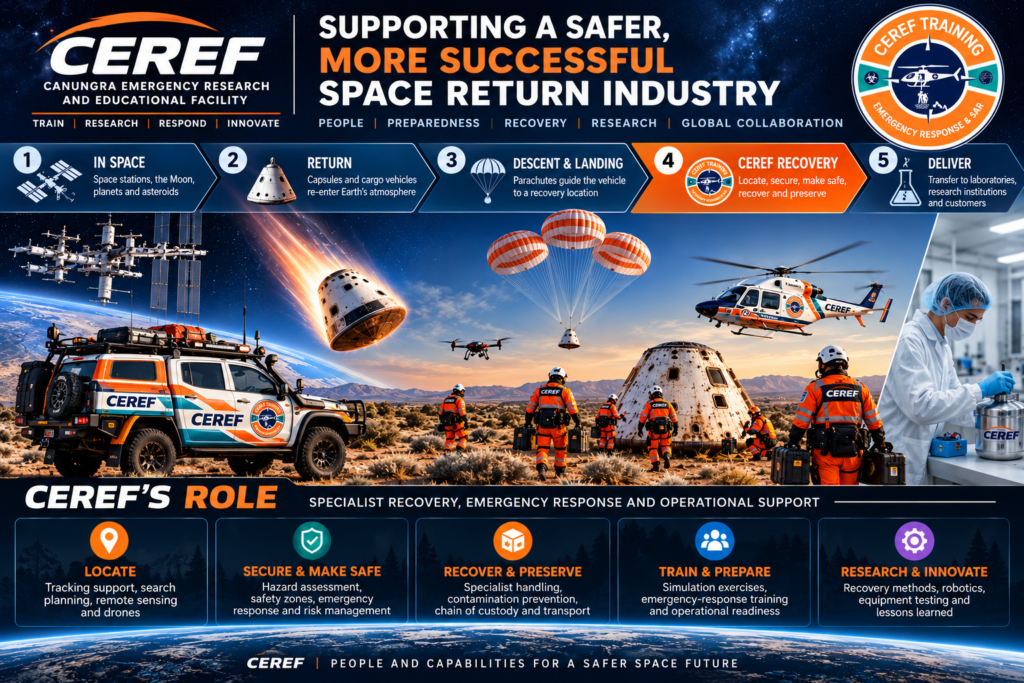
As commercial space operations expand, safely returning people, spacecraft, scientific samples and manufactured materials to Earth will become increasingly important. CEREF—the Canungra Emergency Research and Educational Facility—is developing a collaborative approach to space recovery preparedness, specialist emergency-response training, rescue research and operational contingency planning. Our goal is to help aerospace organisations prepare their people and ground-support systems for both planned returns and unexpected emergencies.
Why space return needs specialist ground readiness
A successful mission does not end at landing. Depending on the vehicle and payload, operators may need tracking and location, secure access, exclusion zones, spacecraft-specific hazard assessment, emergency medical response, marine or remote-area recovery, and protected transport of valuable samples. Each step must be coordinated with the responsible spacecraft operator, licensed recovery-site provider, relevant authorities and receiving laboratories.
What CEREF proposes to develop
CEREF is seeking partnerships to develop practical training and research activities in:
(1) spacecraft landing and recovery simulations;
(2) emergency response to damaged or off-nominal vehicles;
(3) land, aviation and maritime recovery coordination;
(4) incident command, communications and multi-agency exercises;
(5) scientific payload preservation and chain-of-custody training with qualified partners; and
(6) testing of drones, robotics and remote assessment tools. These are proposed programmes and would be developed with mission-specific technical information, funding, appropriate authorisations and industry partners.
Expertise behind the CEREF vision
CEREF’s board brings together experience from aerospace, emergency services, safety, aviation, maritime operations, technology and organisational leadership. This breadth supports an integrated approach to response planning rather than treating spacecraft recovery as a single technical task.
David Bushman — Aerospace and disaster preparedness
David Bushman brings extensive experience in safety management, emergency and disaster preparedness, response and recovery, with a specialised background working with NASA in aerospace safety. His experience includes safety oversight associated with Space Shuttle solid rocket motors, rocket testing operations, and spaceport safety compliance. He also brings practical experience participating in emergency exercises and responder training, with a strong understanding of operational risk management, safety systems and emergency preparedness in complex, high-risk environments.
David’s background provides CEREF with a valuable aerospace safety perspective, particularly in relation to its proposed space recovery activities. His expertise supports the development of appropriate safety frameworks, risk management processes and emergency response considerations for future space recovery operations, helping bridge the requirements of aerospace safety with emergency management and specialist recovery capabilities.
Troy Cuff- Safety and Emergency Response.
Troy is the Founder and Chairman of CEREF, bringing more than 30 years of extensive experience across emergency management, safety, emergency services and responder training. His career encompasses significant expertise in disaster preparedness, response and recovery, including supporting communities and emergency responders through complex and challenging incidents. Troy’s leadership is underpinned by a strong commitment to building organisational resilience, strengthening emergency response capabilities and equipping individuals and teams with the knowledge, skills and confidence to respond effectively when it matters most.
Noel Png- Technology
Noel brings valuable expertise in space technology, satellite imagery and artificial intelligence (AI), with a focus on the application of emerging technologies to enhance situational awareness, operational intelligence and informed decision-making. His experience encompasses the use of advanced satellite data, remote sensing and AI-driven capabilities to support the collection, interpretation and analysis of critical information, particularly in complex and rapidly evolving environments. These capabilities offer significant opportunities to strengthen emergency management, disaster preparedness and response through improved visibility of developing situations, more effective monitoring of affected areas and the timely delivery of actionable intelligence to decision-makers and responders. Noel contributes a forward-looking technology perspective to CEREF, supporting the integration of innovative solutions that improve resilience, preparedness and response capability.
Adam Bernhardt- Aviation Safety
Adam brings extensive experience in aviation safety systems, with particular knowledge of helicopter operations and the specialised safety requirements associated with rotary-wing aviation. His expertise encompasses aviation risk management, operational safety frameworks, hazard identification, incident prevention and the development and application of robust safety management systems. Through his understanding of the operational complexities and challenges of helicopter activities, Adam contributes valuable insight into maintaining safe, effective and reliable aviation operations, particularly in demanding and high-risk environments.
His experience is particularly relevant to emergency management, disaster response and other operational activities where helicopters play a critical role in aerial assessment, reconnaissance, personnel deployment, logistics and the delivery of essential services. Adam’s contribution to CEREF strengthens its aviation safety perspective, supporting the integration of sound safety practices, operational risk controls and aviation capabilities into broader emergency preparedness, response and resilience initiatives.
.
Robert Bott- Security and Safety
Robert brings a broad range of experience across defence, law enforcement, counter-terrorism, explosive ordnance and bomb response, and occupational health and safety. His background provides valuable insight into operating within complex, high-risk and security-sensitive environments, where effective risk management, operational preparedness, coordination and disciplined decision-making are essential.
His experience encompasses the challenges associated with managing security threats, responding to critical incidents, assessing operational risks and supporting the safety of personnel and the wider community. Robert also contributes an understanding of the importance of inter-agency cooperation, established response frameworks, operational procedures and the integration of safety considerations into complex activities.
Matt Cartwright- Water Safety
Matt brings practical operational experience across search and rescue, water rescue, remotely piloted aircraft (drone) operations and emergency response training. His background provides valuable insight into the planning, coordination and delivery of specialist response activities, particularly in challenging, time-critical and potentially hazardous environments.
His experience in search and rescue contributes an understanding of the operational requirements involved in locating, accessing and assisting missing, stranded or endangered persons. This includes the importance of effective search planning, situational awareness, resource coordination, communications and collaboration between emergency services and specialist response teams.
Lydia Halim- HR and Governance.
Lydia brings a broad organisational and strategic perspective to CEREF, supporting key areas of governance, health, workforce capability, operational management and organisational development. Her contribution focuses on strengthening the structures, systems and people that underpin an effective, sustainable and accountable organisation.
In the area of governance, Lydia supports the development and maintenance of appropriate organisational frameworks, policies, procedures and accountability mechanisms to promote sound decision-making, transparency and organisational integrity. Her involvement helps ensure that CEREF’s activities are supported by clear governance arrangements, effective oversight and alignment with its strategic objectives.
A practical, staged approach
CEREF proposes to begin with industry consultation and hazard/competency mapping; progress to tabletop and field exercises; and then, subject to demand and funding, develop repeatable training packages and specialist simulation infrastructure. Any real-world recovery role would require agreements with the responsible operator, regulators and other competent organisations. CEREF does not currently claim to conduct orbital rescues or provide an operational spacecraft recovery service.
Partner with CEREF
We invite spacecraft manufacturers, spaceports, recovery-site operators, research institutions, universities, government agencies, emergency services and technology developers to help define the next generation of recovery preparedness. Together we can identify operational gaps, design realistic exercises and strengthen safety before an emergency occurs. Contact CEREF to discuss a technical workshop, research partnership or pilot training exercise.
United We Stand to Serve Humanity
CEREF’s vision is to help train the people and develop the systems that protect lives and valuable scientific work—on Earth and in support of the space industry


While space rescue operations have not been needed frequently, the potential risks associated with space travel make it essential to have robust plans and capabilities in place. Continuous advancements in technology, improved spacecraft design, and international cooperation contribute to enhancing space rescue capabilities and ensuring the safety of all space travellers.